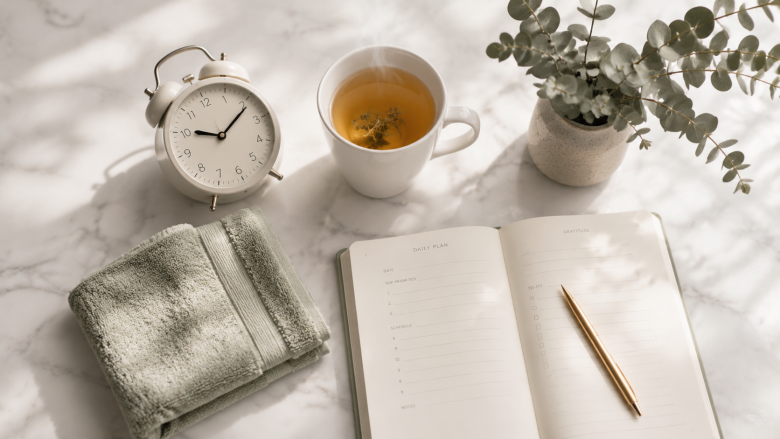
Why Most Self-Care Advice Fails the Overwhelmed
When I first tried to build a self-care routine, I made the classic mistake: I printed out a list of 99 activities and tried to cram them into my week. Meditation, journaling, yoga, walk, face mask, gratitude list, declutter, water tracker... I lasted four days. Then I felt worse than before - guilty for not doing enough self-care.
Here's the thing nobody tells you: self-care is not the number of items you check off. It's the small, consistent pauses that keep you from burning out. If you're exhausted, overwhelmed, or just busy, you don't need a 99-item menu. You need a 10-minute skeleton that fits into your life like a key into a lock.
This article gives you exactly that: a simple self-care schedule built around three 10-minute blocks per day. I've used this template for over two years, and I've helped dozens of friends adapt it to their own energy levels. It's not perfect, but it's honest. And it works when nothing else does.
The Core Problem: Decision Fatigue
Most self-care routines fail because they require you to decide what to do, when to do it, and whether you have the energy. By the time you've answered those three questions, you've already spent your mental reserve. The solution is to remove the decision entirely.
I call this the anchor-habit method. You attach one self-care action to something you already do every day without thinking: brushing your teeth, making coffee, getting into bed. The anchor is the trigger. The self-care is the 10-minute follow-up.
For example, I anchor my morning self-care to the moment I finish my first glass of water. That's my cue to do a 10-minute body scan. No thinking. No checking a list. Just the habit chain.
The 10-Minute Self-Care Schedule Template
Here is the minimal daily template. It has three blocks: morning reset, midday pause, evening wind-down. Each block is exactly 10 minutes. You can swap activities based on your energy level (more on that below), but the structure stays the same.
Morning Reset (10 minutes after your first anchor habit)
Your anchor: after you pour your coffee/tea, after you brush your teeth, or after you sit down at your desk. Pick one. Do not skip the anchor.
- Low-energy morning: Sit in one spot and breathe slowly for 10 minutes. Count your exhales from 1 to 10, then restart. That's it. No app, no timer, no music.
- Medium-energy morning: Do a 10-minute gentle stretch from your bed or chair. Focus on your neck, shoulders, and hips. You don't need a mat or special clothes. Just move.
- High-energy morning: Write three things you're looking forward to. Not a gratitude list (that's different). Just things you're curious about today. It shifts your brain from survival mode to engagement.
If you want a structured routine that takes under 15 minutes, check out our guide on Morning Self-Care Routine in Under 15 Minutes. It gives you a few more options that still respect the anchor-habit principle.
Midday Pause (10 minutes, ideally before lunch)
Most people crash around 2-3 PM. That's not a willpower problem; it's a circadian dip. Instead of fighting it with caffeine, use this block to reset.
- Low-energy midday: Close your eyes and listen to one song - the same song every day. Your brain will associate that song with a reset, and it will start calming you down before the song even ends.
- Medium-energy midday: Walk around your block or building for exactly 10 minutes. No phone, no podcast. Just look at the sky or the trees. If you can't go outside, stand up and stretch for 10 minutes with your eyes closed.
- High-energy midday: Do a 10-minute declutter of one surface - your desk, your kitchen counter, your nightstand. The visual clarity translates to mental clarity.
For more quick ideas that fit this block, our article 15 Quick Self-Care Ideas for Busy Schedules has a dozen more that each take 10 minutes or less.
Evening Wind-Down (10 minutes after your last meal or before bed)
This is the most important block for sleep quality. Do not skip it. Your anchor: after you brush your teeth at night, or after you turn off the TV. Pick one and stick to it.
- Low-energy evening: Lie down in the dark and do a body scan from your toes to your head. Just notice tension. Don't try to relax it - just notice. The noticing alone will release it.
- Medium-energy evening: Write down one thing that went well today and one thing you'll do differently tomorrow. This is not a journal entry. Keep it to two sentences max.
- High-energy evening: Do a 10-minute gratitude journaling session. If you're new to this, see our guide on How to Start Simple Gratitude Journaling Daily. It has a simple three-step method that avoids the common trap of writing repetitive lists.
How to Customize for Low-Energy vs. High-Energy Days
This is where most templates fail. They assume you'll have the same energy every day. You won't. Some days you'll crawl out of bed. Other days you'll bounce. The schedule above already has three energy levels built in, but here's a deeper strategy.
I keep a small whiteboard next to my desk. Every morning, I draw a simple circle and fill it in based on how I feel: empty circle = low energy, half-full = medium, full = high. Then I choose the corresponding activity for each block. No extra thinking. The decision is already made.
One thing I learned the hard way: never try to do a high-energy activity on a low-energy day. It feels like failure, and it reinforces the cycle of guilt. Instead, embrace the low-energy option. A 10-minute sit is still self-care. It's not a consolation prize; it's the correct choice for that day.
The Weekly Skeleton: A Done-for-You Grid
To reduce decision fatigue even further, here's a weekly skeleton. Print it, save it, or adapt it. The key is that each day has a theme, so you don't have to reinvent the wheel every morning.
| Day | Morning Reset (10 min) | Midday Pause (10 min) | Evening Wind-Down (10 min) |
|---|---|---|---|
| Monday | Breathe & count exhales | One-song reset | Body scan |
| Tuesday | Gentle stretch | Walk around block | One good thing + one change |
| Wednesday | Three things I'm looking forward to | Declutter one surface | Gratitude journaling |
| Thursday | Breathe & count exhales | One-song reset | Body scan |
| Friday | Gentle stretch | Walk around block | One good thing + one change |
| Saturday | Three things I'm looking forward to | Declutter one surface | Gratitude journaling |
| Sunday | Choose whatever feels right | Choose whatever feels right | Choose whatever feels right (but keep it 10 min) |
Sunday is your free day. Use it to experiment with a new activity, or just repeat something you loved from the week. The point is that you have a default, so you never have to start from zero.
What Can Go Wrong (And How to Fix It)
I've been using this template for two years, and I've hit every pothole. Here are the most common breakdowns and what I do about them.
Problem: You forget to do the block entirely.
This happens when the anchor habit isn't strong enough. Solution: pair the anchor with a physical cue. For example, I put a sticky note on my coffee mug that says "10 minutes." I also set a recurring alarm on my phone with no label - just a vibration. The vibration is enough to remind me.
Problem: You start but then get distracted.
Set a timer. I use the timer on my stove, not my phone, because my phone is a distraction machine. If you must use your phone, put it face-down in another room. The 10 minutes are short enough that you can survive without it.
Problem: You feel guilty for only doing 10 minutes.
This is the most insidious trap. You think: "Real self-care should be an hour of yoga or a bubble bath." No. Real self-care is what you can sustain. An hour of yoga that you never do is useless. Ten minutes of breathing that you actually do is transformative. Give yourself permission to start small.
Hydration: The Forgotten Self-Care Anchor
One thing I added to my template after six months was a hydration check. I noticed that on low-energy days, I was often just dehydrated. Before I chose my morning activity, I'd drink a full glass of water. That alone changed my energy level enough to maybe bump me from low to medium.
If you struggle with drinking enough water, our article on 12 Simple Hacks to Stay Hydrated All Day has practical tips that don't require buying a fancy bottle. I use the "two sips before every bite" rule, and it works.
Creating a Physical Space for Self-Care
You don't need a dedicated room, but having a small corner that signals "this is my reset space" helps. I cleared a corner of my bedroom, put a floor cushion, a small plant, and a lamp with a warm bulb. That's it. No essential oil diffuser, no crystals, no yoga mat. Just a spot that my brain recognizes as the self-care zone.
When I sit there, my body automatically switches into a calmer state. It's called context-dependent memory, and it's real. If you want to set up something similar, check out our guide on How to Set Up a Simple Home Yoga Corner. It's not just for yoga - it works for any self-care practice.
Why Only 10 Minutes? The Science of Micro-Habits
Most people don't realize that the brain's resistance to a task is highest at the start. The first three minutes of any activity feel like a slog. Then the resistance drops. Ten minutes is long enough to push through that initial resistance but short enough that you can't talk yourself out of it.
Research on habit formation, like the work by Dr. BJ Fogg at Stanford, shows that the key to lasting change is making the behavior so easy you can't fail. Ten minutes is the sweet spot. It's not intimidating, but it's long enough to feel a shift.
I've also found that when I do a 10-minute block, I often extend it naturally. I'll sit down to breathe and end up staying for 15 or 20 minutes. But I never force it. The extension has to come from a genuine desire, not from guilt.
How to Handle Days When Even 10 Minutes Feels Like Too Much
These days happen. You're sick, you're grieving, you're in the middle of a crisis. On those days, the template shrinks to one minute. Here's my emergency protocol:
- Morning: Take three deep breaths while sitting on the edge of your bed.
- Midday: Drink a glass of water and look out the window for 30 seconds.
- Evening: Put your hand on your heart and say one kind thing to yourself.
That's it. One minute per block. The goal is not to feel better; the goal is to maintain the habit chain so you don't have to rebuild it from scratch when you're back on your feet. This is the most important lesson I've learned: self-care is not about performance. It's about showing up, even if you show up for only one minute.
The 30-Day Challenge: Try It and Adjust
I challenge you to try this template for 30 days. Don't change anything for the first week. Just follow the skeleton exactly as written. In week two, start swapping activities based on your energy level. In week three, adjust the anchors to fit your actual schedule. In week four, add one more block if you want - but only if you truly want to, not because you think you should.
Here's a printable checklist you can use. I keep it on my fridge:
- Morning anchor (e.g., finish coffee): ___
- Morning activity (circle one): low / medium / high
- Midday anchor (e.g., before lunch): ___
- Midday activity (circle one): low / medium / high
- Evening anchor (e.g., after brushing teeth): ___
- Evening activity (circle one): low / medium / high
After 30 days, you'll know what works for you. Maybe you'll discover that the midday pause is better at 10 AM than 2 PM. Maybe you'll realize that the low-energy options are actually your favorite. The point is to gather data, not to judge yourself.
Final Thoughts: The Real Self-Care Is the Structure
I've tried dozens of self-care routines over the past decade. The ones that lasted more than a month all had one thing in common: they were boring. They were simple. They didn't require me to be creative or motivated. They just required me to show up for 10 minutes, three times a day, anchored to habits I already had.
If you're exhausted, you don't need inspiration. You need a system that works when you have zero energy. That's what this template is. It's not glamorous. It's not revolutionary. But it's honest, and it's sustainable.
Start tomorrow. Pick one anchor. Do one 10-minute block. If you miss it, don't panic. Just do the next one. And remember: the best self-care schedule is the one you actually follow.